
Nano Aquariums
Stocking and set-up in nano aquaristics.
Nano aquariums have become firmly established in the hobby in recent years and are now a permanent feature. What was once considered a niche for specialists has become widely accessible, and for many, a nano tank is now the first step into aquatics.
This is partly due to the manageable level of maintenance. Changing 5 litres of water is far quicker and easier than dealing with 200 litres. At the same time, a well-designed nano cube is visually striking and highly appealing. Another key advantage is practicality. A small aquarium with a volume of around 20 litres is quick to set up and easy to move. It does not require specialised furniture or structural considerations and can be placed on a cabinet or even a desk. This makes it easy to integrate into everyday living spaces.
The development of suitable equipment has also played an important role. Dennerle, in particular, has been a pioneer in this field, bringing stylish Nano Cubes and Scaper’s Tanks into the mainstream. With the addition of well-designed accessories, there is no longer any need for improvised solutions when setting up a small aquarium.
Modern equipment, such as the Nano Style LED lighting and the shrimp-safe Nano Corner Filter, has made nano aquariums far more user-friendly. There are even specially designed cleaning tools, such as compact magnetic cleaners that can easily reach the rounded corners of the cubes. The seamless, rounded front edges of Dennerle aquariums have also become a distinctive design feature.
In addition to the classic cube-shaped Nano Cubes, rectangular Scaper’s Tanks are now available in various sizes. These offer more space for creative layouts, particularly due to their larger base area relative to their height. This makes them especially suitable for aquascaping. They are also ideal for dwarf crayfish, which spend most of their time on the substrate and benefit more from floor space than from water depth.
As keeping fish in very small aquariums is restricted in some countries, nano tanks were once mainly used by specialist breeders. Today, however, dwarf shrimp and dwarf crayfish have become increasingly popular, and nano aquariums are perfectly suited to their needs. Colourful dwarf shrimp can be kept successfully in tanks of 20 litres or more, and even a single betta can thrive in a well-planted nano aquarium.
Setting up a nano aquarium is straightforward and does not require extensive equipment. A suitable substrate is essential. Water-neutral shrimp gravel in smaller packs is particularly practical, as it avoids excess material. Nutrient-rich substrate, such as Nano DeponitMix, can be added under challenging plants.
A useful tip
Leave a small gap of around 2 cm between the nutrient substrate and the glass. This prevents visible layering at the front of the aquarium. For species such as bee shrimp that require soft water, Shrimp King Active Soil can be used to help adjust water parameters accordingly.
For particularly strong plant growth, Scaper’s Soil offers a pre-fertilised option that supplies nutrients over an extended period. Decorative accents can be added with natural stones in various shapes and colours. The design possibilities are wide-ranging and limited only by the dimensions of the aquarium.
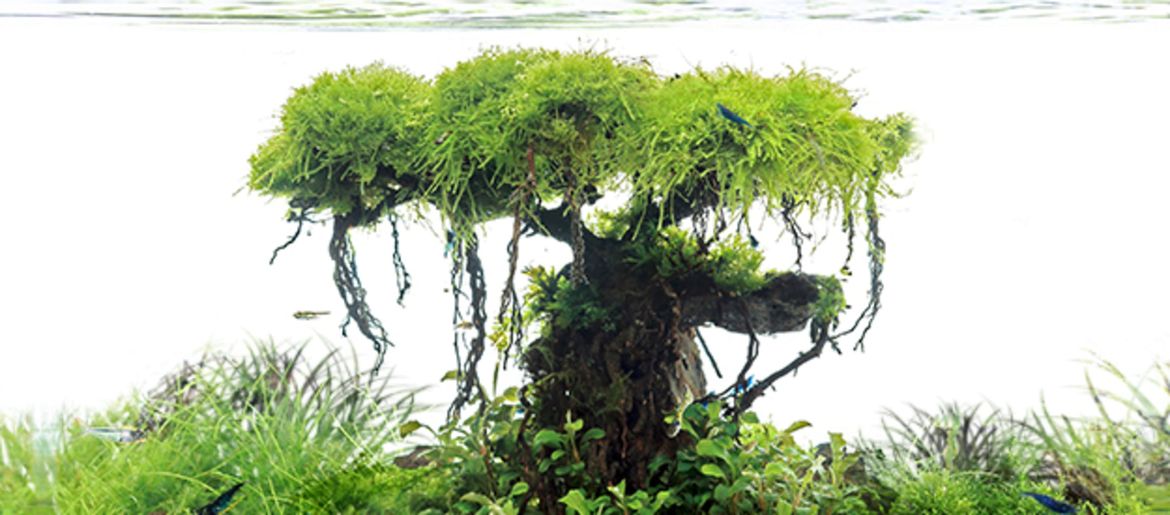
Hardscape elements such as roots and stones form the structural basis of the layout and are typically placed in the midground. When selecting stones for soft water aquariums, it is important to avoid calcareous materials, as these can increase water hardness. A simple test with vinegar can help identify such stones.
Hardscape elements can be enhanced with mosses or epiphytic plants such as Anubias or Bucephalandra. During planting, it is advisable to keep plants moist to prevent drying. Adding only a small amount of water at first makes planting easier and prevents disturbance of the substrate.
In nano aquariums, compact plant species are generally preferable, as they require less maintenance. Otherwise, it will involve frequent and careful, painstaking work with plant tweezers. Mosses and small foreground plants such as Marsilea or Glossostigma are well-suited for the foreground. Slightly taller plants can be used in the midground, while background plants should be chosen with care to avoid overcrowding, particularly in cube-shaped tanks.
Filling the aquarium can be done carefully using a watering can or by directing the water onto a surface such as a small dish to prevent disruption. The filter can then be installed in a rear corner, and additional equipment such as a heater can be added if required. Once everything is connected, the system is ready to run.
Before introducing live fish, allow the aquarium to run for two to three weeks. This allows beneficial bacteria to get established and ensure stable water conditions.
Enjoy your nano aquarium!
Related products
-
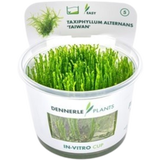
Dennerle Plants Taxiphyllum alternans 'Taiwan' CUP
- Origin: Asia
- Dense & branched growth
- For detail-rich aquascapes
-
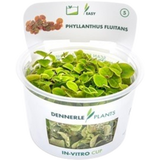
Dennerle Plants Phyllanthus fluitans CUP
- Origin: South America
- Floating plant
- Open tanks & paludariums
-
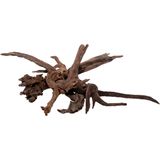
Olibetta Riverwood, L
- Beautiful driftwood - real wood!
- For freshwater aquariums and terrariums
- Rich in fibre, important for catfish and invertebrates
-
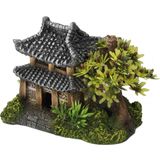
Europet Asian House
- Made of high-quality polyester resin
- Completely harmless to ornamental fish
- Non-toxic and pH neutral